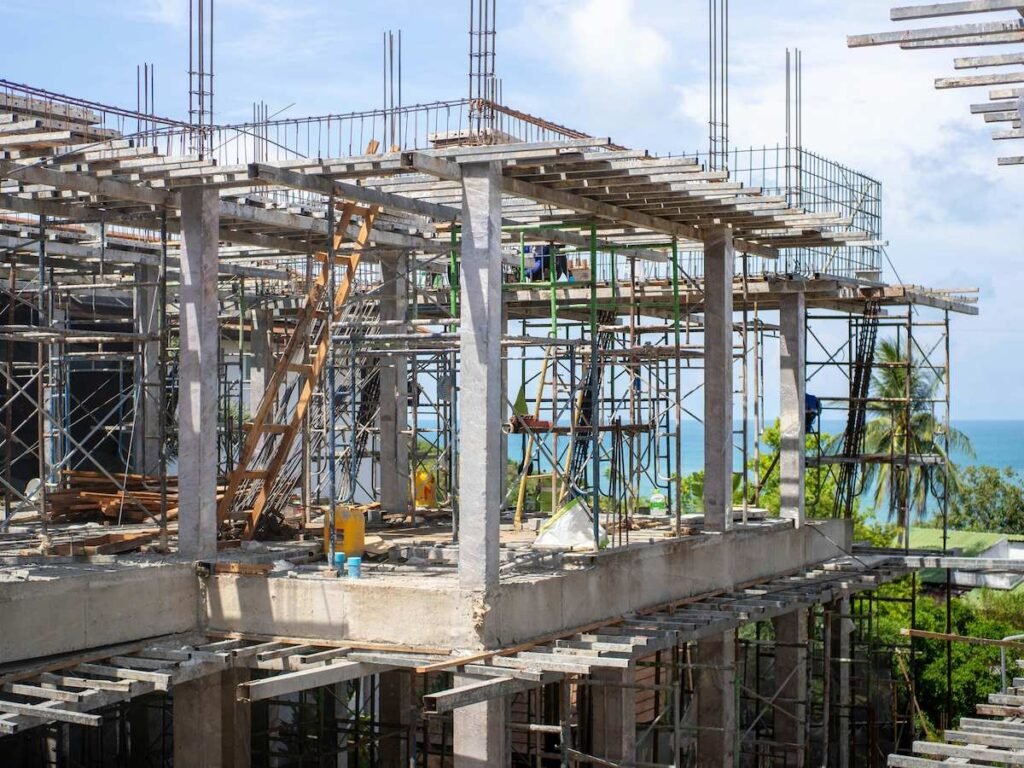
An architect's guide to land viability, reclaimed mine ground, and what Phuket's master-planned coast asks of a design.
Bang Tao is the most successful piece of land rehabilitation in Phuket’s history, and that history is the key to understanding it. The long bay on the island’s northwest coast was a tin-mining heartland for centuries, worked by British, Dutch, French and Chinese operations that left behind pits and acid-laden soil. When tin collapsed in the 1970s the land was considered worthless. In 1984 the founders of Laguna Phuket acquired 222 hectares of that degraded ground, remediated the soil, planted thousands of trees, and converted the mining pits into the lagoons that now define the area. Today Bang Tao is one of the island’s premier addresses, anchored by the master-planned Laguna estate, Boat Avenue, and a deep concentration of resorts, branded residences, and international schools.
For someone considering building here, this origin is not a charming anecdote, it is the central technical fact. Much of Bang Tao sits on reclaimed former mine land and around a man-made lagoon hydrology, which makes ground conditions, drainage, and environmental approval the real determinants of a project, not the flat openness the area presents. The honest story of Bang Tao is that it is genuinely excellent land to build on when the ground and the structure are properly understood, and a costly mistake when they are not.
This guide is written from an architect’s perspective. It assumes you are at the stage of asking whether Bang Tao is right for your project, and what a sensible building on land here might look like.
Important update before going further
The defining facts about Bang Tao are its mining history, its engineered ground and water, and the estate structure that governs much of it.
The points worth knowing for Bang Tao specifically:
Much of the area is former tin-mine land with historically acidic and disturbed soils, professionally remediated in the Laguna core but variable elsewhere, which makes a plot-specific soil investigation essential rather than routine
The lagoons are a man-made, managed hydrological system, and proximity to it affects ground water, drainage, and flood design in ways a natural coastal plot would not
Large parts of Bang Tao sit within the master-planned Laguna estate, where covenants, design controls, and management structures are part of what is bought, distinct from open-market land outside it
Significant developments here require Environmental Impact Assessment approval, a live current requirement for larger projects, which affects timeline and feasibility
The headline December 2024 elevation relaxation is secondary along the flat coastal land but relevant on the inland rises buyers take for sea views, and the northern end of the bay runs toward Layan and the Sirinat National Park boundary, where protected-area verification becomes necessary.
The land, what is actually there
Bang Tao runs along a six to eight kilometre bay on the northwest coast, predominantly a flat coastal and reclaimed plain, with the Laguna estate and its lagoons occupying a substantial planned area, Cherngtalay providing the inland daily-life centre, and low hills rising inland and toward Layan to the north. The land divides into distinct categories that carry very different ground conditions, rules, and prices: the planned Laguna estate land around the lagoons, the open-market plains east of the beach in and around Cherngtalay, the beach and near-beach strip, and the inland and Layan-edge rises where buyers pursue elevation and sea views.
This matters for site selection more than the pleasant flat appearance suggests, because at Bang Tao the history and category of a plot, not its topography, decide its real character. Reclaimed mine ground can carry variable bearing capacity, residual soil chemistry, and made-ground conditions that demand investigation. Estate land within Laguna carries the protections and constraints of a master plan. Open-market plains land in Cherngtalay is where much of the villa development sits and is more variable in servicing and ground than the engineered estate. The beach strip carries the coastal setback. The northern Layan edge approaches protected land. The first question for any Bang Tao plot is which of these it is, because that determines both its price and its risks.
The maturity of the area also matters. Bang Tao is highly developed and rapidly appreciating, with thousands of delivered units and a heavy development pipeline. That brings exceptional amenity and infrastructure, but it also means prime land is scarce and premium-priced, transactions are often within sophisticated structures, and the due diligence has to match the complexity of what is being sold.
Zoning, the lagoon land, and title
Phuket construction is governed primarily by the Building Control Act and the Town and City Planning Act, refined by Ministerial Regulations and environmental notifications. In Bang Tao the decisive factors are the ground conditions of reclaimed land, the lagoon hydrology, the estate rules where a plot sits within Laguna, the coastal setback on the beach side, and the Environmental Impact Assessment requirement for larger projects, so the classification and category of the specific plot govern everything rather than being a formality.
On the open-market and inland land, the zoning is predominantly residential and mixed-use, permissive for the villa, family home, or small mixed-use building typical here. The general inland height position applies away from the coastal caps, but the precise permitted height, area, and use depend on the specific zone and must be confirmed for the individual plot, and the access road width and status govern setback and height as everywhere on the island. On any inland rise taken for sea views, the slope rules apply, with a gradient at or above 35 degrees treated as unbuildable and gentler slopes carrying engineering and drainage obligations.
On the beach side, the coastal setback applies, with no building directly on the shore, a setback from the high-tide line typically reflected in the title boundary, and height and footprint limits in the sensitive near-shore strip. The rule that beaches are public is absolute, so a near-beach plot does not include the beach, and any presentation implying private beach is misrepresenting the law.
Where a plot sits within the Laguna estate, an additional and significant layer applies. A master-planned estate carries covenants, architectural and design controls, shared infrastructure, management arrangements, and often specific ownership structures, and these are part of what is being bought. Buying within Laguna can deliver genuine quality assurance, remediated ground, and managed services, but it constrains design freedom and carries ongoing obligations, and the estate documentation must be reviewed as carefully as the title itself. For larger developments anywhere in Bang Tao, Environmental Impact Assessment approval is a current and material requirement that affects both feasibility and timeline, as recent approved projects in the area demonstrate.
Title diligence in Bang Tao is the high-stakes version of the universal rule, given the land values and the structural complexity. Proceed only on a Chanote, the full freehold title, verified at the Land Office with its history, boundary, access and utility easements, and any estate or coastal-setback relationship confirmed by a qualified lawyer. Where the route is condominium freehold, the unit must sit within the building’s foreign quota with that position verified. The standard reference points for a Bang Tao assessment are the Phuket City Land Use Planning Map for zoning, the plot’s category and its relationship to the Laguna estate and the lagoon system, the coastal setback and any northern protected-area proximity, the EIA position for larger projects, and a clean Land Office title check, all verified with the provincial Department of Public Works and Town and Country Planning office and a qualified lawyer before any commitment.
What a good Bang Tao design responds to
The design drivers in Bang Tao are the reclaimed ground, the west-coast orientation, the lagoon hydrology, and the premium context.
The ground is the first and most Bang Tao-specific response. On former mine land, foundation design cannot proceed on assumption. A thorough plot-specific geotechnical investigation establishes bearing capacity, the depth and nature of any made ground, residual soil chemistry, and water table, and the foundation strategy follows from that rather than from a standard detail. This is the single technical point that most distinguishes competent from incompetent building at Bang Tao, and it is the point a non-specialist most often underestimates.
The west-coast orientation is the second. Bang Tao faces the afternoon and sunset sun, the condition that punishes a careless design across the whole west coast. Deep overhangs, recessed and shaded openings, operable louvres and screens, low-emissivity glazing, and roof forms that shade the western facade are the standard tools, and the near-universal buyer brief of a glazed wall to the sunset is precisely the brief that needs the most disciplined architectural answer.
The lagoon hydrology and drainage are the third. Proximity to the managed lagoon system and the flat reclaimed plain means ground water and surface drainage have to be engineered, finished floor levels set deliberately, and stormwater handled for the heaviest rain late in the year. A design that ignores the water context on this kind of ground will not perform. The premium context is the fourth: at Bang Tao price points the build quality, material specification for the coastal salt-air environment, and the integration of pool, landscape, and indoor-outdoor living must match the land value, and where a plot is within Laguna the estate’s design controls are a design input from the outset rather than an approval hurdle at the end.
Lifestyle and who Bang Tao suits
Bang Tao offers one of the most developed upscale lifestyles on the island: the long beach, the Laguna resort and golf estate, beach clubs, the Boat Avenue and Porto de Phuket dining and retail, international schools within a short drive, and the airport around twenty-five to thirty minutes north. It is refined and family-capable rather than raucous, and international rather than local in character. Its appeal is a premium, amenity-dense coastal life on professionally planned land, and its trade is cost and the scarcity of prime plots.
For an architect’s client the choice is about priorities and category. Bang Tao suits buyers building a high-value primary residence, a family home near international schools, a refined second home, or a managed rental who want established premium infrastructure and accept the premium and the diligence that come with it. It is also one of the areas where condominium freehold is a genuinely sensible route for a buyer wanting secure freehold title without land-structure complexity. It is rarely the right area for a budget-led build, and never a place to economise on the geotechnical and legal diligence given both the ground history and the sums involved.
A practical sequence for evaluating a Bang Tao plot
In Bang Tao the order of checks begins with category and ground, because an estate plot, an open-market plain plot, a beach plot, and an inland rise are different decisions, and the mine history makes ground a first-order question.
Start by establishing the plot’s category and its relationship to the Laguna estate and the lagoon system, then confirm the title, a Chanote verified at the Land Office, with boundary, access and utility easements, and any estate documentation confirmed by a qualified lawyer, or the foreign-quota position if the route is condominium freehold. Then confirm the zoning classification and the permitted height, area, and use, the access road status, the coastal setback if near the beach, and any protected-area proximity at the northern Layan edge. Then, for any larger project, establish the EIA position. Only once these are clear should you commission the plot-specific geotechnical and drainage investigation, which on former mine land is decisive, and then the feasibility brief.
Most reputable architects on the island, including this practice, will conduct a preliminary land viability assessment before any design work begins. In Bang Tao this matters specifically because the land’s mining past means a flat, attractive, premium-priced plot can still carry ground conditions that govern the entire project budget, and that has to be understood before capital is committed rather than after.
Final thoughts
Bang Tao is one of the best places to build on Phuket, precisely because so much of it was so carefully reclaimed and planned. But the same history that makes it excellent is the history a buyer must understand: former mine ground, a man-made lagoon hydrology, a master-planned estate structure over much of it, and a live EIA regime for larger projects. The flat openness is the result of decades of engineering, not an invitation to build without it.
For a buyer who wants premium, amenity-dense coastal living, who chooses the right category of plot for their brief, and who matches the investment with disciplined geotechnical and legal verification, Bang Tao is among the strongest choices on the island. For a buyer who reads the flat land as simple and skips the ground and structural diligence, it is a place where the cost of that assumption is high. For the right brief, properly handled, it is exceptional.
If you are weighing a plot in Bang Tao, the most useful first step is a site assessment that establishes the plot’s category, the estate and lagoon relationship, title, zoning, the EIA position where relevant, and above all the ground conditions together, not separately. That assessment is offered as the first stage of every project this practice takes on.
Considering land in Bang Tao, Layan, Cherngtalay, Surin, or elsewhere in Phuket? Get in touch for a preliminary land viability assessment. You can also visit our YouTube channel for videos about these areas, and find essential planning advice at www.thetropicalarchitect.com
Note on regulations: zoning, height, coastal setback, slope, estate, environmental and EIA rules are subject to change and to local enforcement variations, and the ground conditions of former mine land, the distinction between estate and open-market land, and the absolute rule that beaches are public are matters to verify carefully for any specific plot. Always confirm current rules and the title, category, ground, and position with the Phuket provincial Department of Public Works and Town and Country Planning office, the Land Office, and a licensed Phuket architect or legal advisor before relying on this guide for any acquisition or build decision.