An architect’s guide to land viability, mangrove and title risk, and what Phuket’s quiet eastern bay asks of a design.
Pa Khlok is the green, watery edge of Phuket that most visitors never see. It sits on the northeast coast, part of Thalang District, set around a mangrove bay rather than a swimming beach, and it is widely recognised as a distinct community for its verdant surroundings and its quiet, nature-led character. It is one of the parts of the island where people settle for calm and a bay-view life rather than tourism, and where land is markedly cheaper than the west coast.
For someone considering building here, whether a private home, a nature-oriented residence, or a long-term rental, Pa Khlok presents a genuine combination of value and risk. The setting is beautiful and the land is affordable. But the two defining facts about Pa Khlok are regulatory rather than scenic: it is a protected mangrove and wetland environment, and verdant eastern Phuket has a documented history of title problems. Both have to be understood before the scenery.
This guide is written from an architect’s perspective. It assumes you are at the stage of asking whether Pa Khlok is right for your project, and what a feasible building on land here might actually look like.
Important update before going further
Two regulatory realities matter more in Pa Khlok than the general island rules.
The first is mangrove and wetland protection. Mangroves, wetlands, and the bay margins are designated environmental protection areas in Phuket, where building is heavily restricted or prohibited outright, and where larger projects can trigger an Environmental Impact Assessment. A plot that fronts or sits near the Pa Khlok mangroves is not a normal coastal plot, and its buildable status cannot be assumed from its appearance or from what a seller says.
The second is title risk. Eastern and verdant parts of Phuket have a documented history of land that was sold privately but is in fact protected land under the Department of National Parks, Wildlife and Plant Conservation. There is no statute of limitations on the state reclaiming such land, structures on it can be ordered demolished, and buyers in these cases have generally received no compensation and no legal recourse. This is the single most important reason that title verification in Pa Khlok is not a formality.
The December 2024 elevation change that relaxed the 80 to 140 metre rule elsewhere on the island is largely secondary here, because Pa Khlok’s land is predominantly low and the binding constraints are the mangrove protection and the title position rather than altitude.
The land, what is actually there
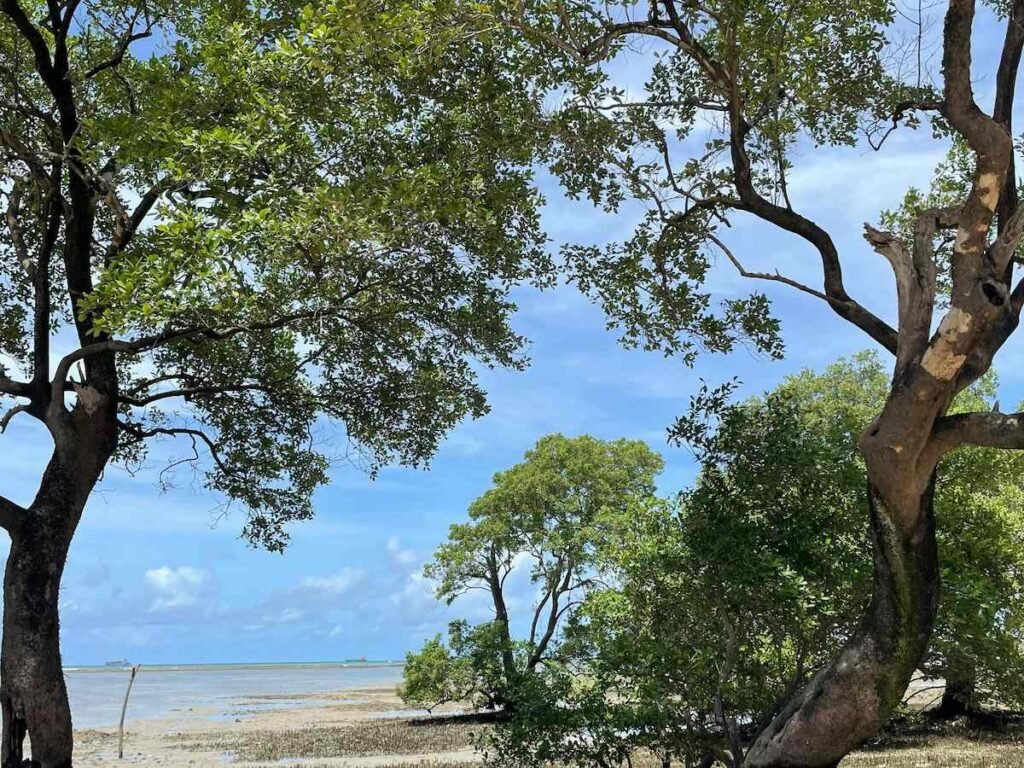
Pa Khlok sits around a shallow mangrove bay on Phuket’s quiet northeast coast, with low flat land near the water and gentle hills rising inland. The shoreline is mangrove and tidal flat, not sand. This is the defining physical fact about the area, and it is the reason Pa Khlok has stayed undeveloped while the west coast filled in: the bay is a working natural ecosystem of mangroves, boats, and tidal water, not a beach.
This matters for site selection more than it first appears. The flat land near the bay looks straightforward to build on, but it is precisely the land most likely to fall within mangrove or wetland protection, to have drainage and ground conditions that complicate building, and to carry the title questions that affect verdant eastern Phuket. The gentle inland rise offers calmer ground and some outlook, but the land toward the protected areas and the National Parks jurisdiction is exactly where buyers have historically been caught. In Pa Khlok the attractive land and the constrained land are frequently the same land.
The shoreline cannot be privately owned, and the mangrove margin is protected beyond the ordinary coastal setback. A plot marketed for its bay frontage is the plot that most needs its boundary, its zone, and its title checked before anything else.
Zoning, mangrove protection, and title
Phuket construction is governed primarily by the Building Control Act and the Town and City Planning Act, refined by Ministerial Regulations and by environmental notifications issued by the Ministry of Natural Resources and Environment. In Pa Khlok, the rules that bind are the environmental protection of mangroves and wetlands, the coastal setback, and the title status of the land, rather than the elevation rules that dominate the hillier districts.
The mangrove and wetland protection is the central regulatory fact. These are designated sensitive zones where development is heavily restricted or prohibited, where the boundary of the protected area is not always obvious on the ground, and where larger residential or tourism projects can require an Environmental Impact Assessment. The practical position is that any plot near the bay must have its environmental zone classification confirmed with the authorities before purchase, because a plot that looks buildable can sit wholly or partly within protected mangrove or wetland land.
The coastal setback applies as it does elsewhere on the island. Nothing may be built directly on the shore, with a no-build setback from the high-tide line that is typically reflected as the boundary on the land title and commonly in the order of 20 metres. Within the strip closest to the high-tide line, building height is restricted to approximately 6 metres, with footprint and open-space limits applying in these sensitive zones. The exact figures depend on the specific zone, which is why the title boundary and the zone classification must be verified for any individual site.
The title position is where Pa Khlok demands the most caution. Given the documented history of protected National Parks land being sold privately in verdant eastern Phuket, the title check here is not a routine conveyancing step but the decisive one. The only safe basis for proceeding is a Chanote, the full freehold title, verified at the Land Office, with its history and its relationship to any protected-area designation confirmed by a qualified lawyer. A lesser title document, or a Chanote whose provenance has not been independently checked, is a serious risk in this specific area rather than a minor one.
The standard reference points for any Pa Khlok site assessment are the Phuket City Land Use Planning Map for the zone classification, the environmental protection designations covering the mangroves and wetlands, the coastal setback against the title boundary, and a thorough Land Office title verification. These are the standard tools, but the rules and the boundaries shift, and the only reliable approach is to verify the position with the Phuket provincial Department of Public Works and Town and Country Planning office, the relevant environmental authority, and a qualified lawyer before any commitment.
What a good Pa Khlok design responds to
If the regulations and the title define what can be built, the bay environment defines what should be built. A bayside site in a mangrove environment is wetter, softer, and more biologically active than a typical coastal plot. Ground conditions near the bay often have low bearing capacity at shallow depth, so pile foundations are common for anything more than a single storey and a plot-specific soil investigation is essential. The tidal mangrove system raises the water table and the humidity load, which makes moisture-resistant detailing, elevated finished floor levels, and careful material selection for a damp salt-air environment central rather than incidental.
Drainage and stormwater are the defining engineering consideration. A mangrove bay margin floods and drains on tidal and seasonal cycles, and the heaviest rain comes late in the year. A site that is calm and dry in the dry season can be saturated or tidally affected in the wet season, and any design that does not engineer for water movement, finished floor level, and surface drainage will fail here. Beyond that, the standard tropical discipline applies and matters more on this less breezy side of the island: deep overhangs, shaded openings, deliberately designed cross-ventilation, and high-level openings to exhaust heat, all reducing the air conditioning dependence that would otherwise dominate running costs.
Lifestyle and who Pa Khlok suits
Pa Khlok is not a lifestyle destination in the resort sense. It has no nightlife, a small local dining and market scene, and larger shopping a drive away to the southwest. Its appeal is the opposite of amenity density: a quiet, green, nature-led setting around a working mangrove bay, with a settled local community and land prices well below the west coast. For an architect’s client the choice is about priorities. A resort district offers beaches, rental yield, and amenity with coastal-zone constraints; Pa Khlok offers calm, nature, and value, with mangrove protection and title risk that make due diligence the decisive stage. It suits buyers building a primary residence or a long-term nature-oriented home who value the setting and the price and will verify the environmental zone and the title properly before committing. It is rarely the right answer for a high-yield tourism investment.
A practical sequence for evaluating a Pa Khlok plot
In Pa Khlok the order of checks matters more than in most districts, because the binding risks are invisible on a site visit and have ruined transactions here specifically.
Start with the title, and treat it as the decisive step rather than a routine one. Confirm a Chanote verified at the Land Office, with its history and its relationship to any National Parks or protected-area designation independently checked by a qualified lawyer. Then confirm the environmental zone classification, specifically whether the plot sits within or against protected mangrove or wetland land. Then check the coastal setback against the title boundary. Only once the title and the environmental status are confirmed clean should you commission a soil investigation, a tidal and stormwater drainage assessment, and the beginning of a feasibility brief.
Most reputable architects on the island, including this practice, will conduct a preliminary land viability assessment before any design work begins. In Pa Khlok this is not a formality. The combination of mangrove protection and the documented title history means a plot here can look idyllic and be legally unbuildable or unsafe to acquire, and the viability assessment is the stage that determines whether a project is worth pursuing at all.
Final thoughts
Pa Khlok is one of the most genuinely beautiful and affordable parts of Phuket, and one of the riskiest to buy in without proper diligence. The mangrove bay that gives it its character is a protected environment, and the verdant eastern land that looks like a bargain is exactly the land that has caught buyers through title problems. None of this makes Pa Khlok a place to avoid. It makes it a place to approach in the right order.
For a buyer who wants a calm, green, bayside home at a sensible land cost, and who is prepared to verify the title and the environmental status properly before committing, Pa Khlok can be one of the most rewarding settings on the island. For a buyer who wants to move quickly on a scenic plot without that diligence, it is one of the places most likely to end badly.
If you are weighing a plot in Pa Khlok, the most useful first step is a site assessment that addresses title, environmental protection, the coastal setback, drainage, and ground conditions together, not separately. That assessment is offered as the first stage of every project this practice takes on.
Considering land in Pa Khlok, Sakhu, Thalang, Mai Khao, or elsewhere in Phuket? Get in touch for a preliminary land viability assessment. You can also visit our YouTube channel for videos about these areas, and find essential planning advice at www.thetropicalarchitect.com
Note on regulations: zoning, environmental protection, coastal setback, and title rules are subject to change and to local enforcement variations, and the protected status of mangrove, wetland, and National Parks land in particular is an area where verification with the authorities is essential. Always confirm current rules and the title position with the Phuket provincial Department of Public Works and Town and Country Planning office, the relevant environmental authority, the Land Office, and a licensed Phuket architect or legal advisor before relying on this guide for any acquisition or build decision.