An architect's guide to land viability, coastal and hillside risk, and what Phuket's busiest town asks of a design.
Patong is the most intense piece of real estate on Phuket, and the temptation when writing about it is to write about the nightlife. That is a mistake for anyone thinking about building here. Beneath the tourism, Patong is a constrained natural amphitheatre, a flat coastal bowl ringed by steep hills, and it carries two of the most serious site considerations on the island: it was among the hardest-hit places in the 2004 tsunami, and its steep hillsides have a documented history of landslides and illegal hillside construction with repeated official enforcement. An honest architect’s guide to Patong is about those two facts and the land between them, not about Bangla Road.
For someone considering building or investing here, Patong offers the highest tourism revenue density on the island and a correspondingly high land cost, alongside the most demanding coastal and hillside risk profile of any west-coast town. The honest story of Patong is that it can be highly rewarding to build in correctly and is one of the least forgiving places on the island to build in carelessly, on either the coast or the hills.
This guide is written from an architect’s perspective. It assumes you are at the stage of asking whether Patong is right for your project, and what a sound building on land here might actually look like.
An important update for Patong landowners
The defining considerations for Patong are coastal resilience and hillside stability, both with documented histories, not the regulatory headline of recent years.
The points worth knowing for Patong specifically:
Patong was among the hardest-hit areas in the 2004 tsunami, with waves widely reported in the multi-metre range, and it now has tsunami warning towers along the beachfront and designated evacuation planning, which makes coastal siting and finished levels a genuine design matter on low ground
The steep hills enclosing Patong have a documented record of landslides and illegal or unsafe hillside construction, including a fatal landslide at a hillside construction site and repeated official stop-work and enforcement actions
The slope and elevation rules apply on those hills with full force, and a gradient at or above 35 degrees is treated as unbuildable, with steep-slope enforcement active in this area specifically
The flat land is largely built out, intensively used, and premium-priced, so much of the available land is on the constrained hillsides where the risk and the rules are most serious
The headline December 2024 elevation relaxation is relevant on the hills but secondary to the central point: Patong is a place where both the coast and the slopes carry demonstrated, not theoretical, risk, and the design has to answer that.
The land, what is actually there
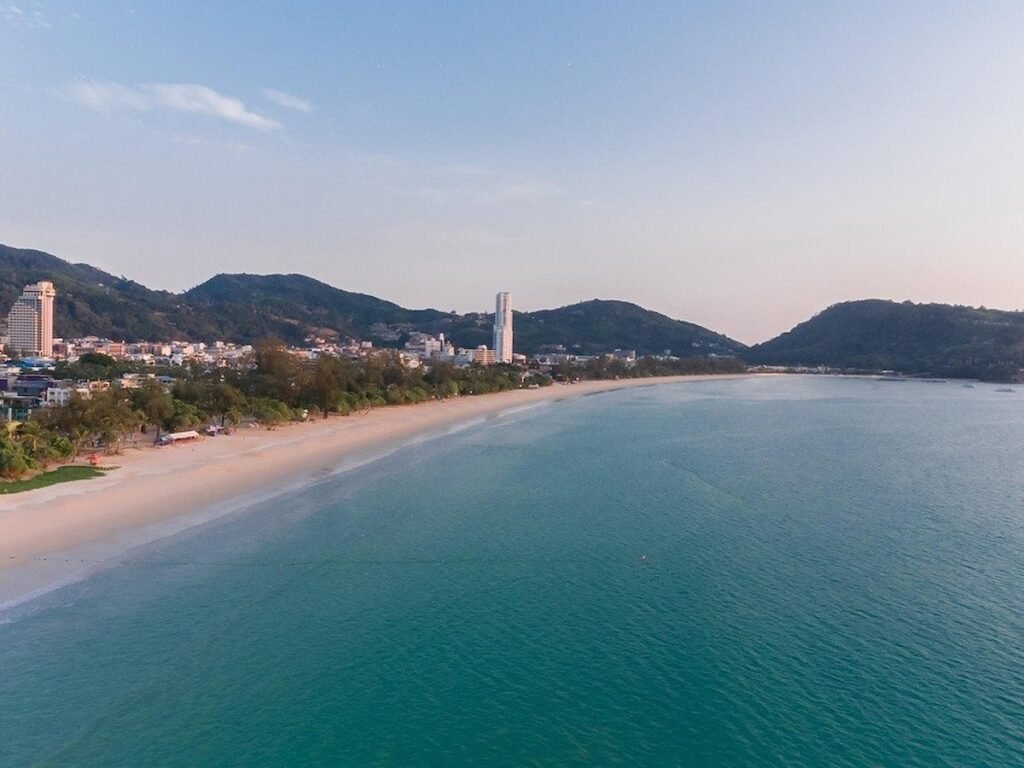
Patong sits on the west coast between Kamala to the north and Karon to the south, a flat coastal bowl wrapped by steep hills on three sides, with the sea on the fourth. The flat land holds the beach, the dense commercial and tourism core, and the bulk of the existing development. The hills rise quickly and steeply behind, and they are the natural boundary that has kept Patong’s footprint contained.
This matters for site selection more than the busy townscape suggests, because in Patong the easy land and the safe land are largely gone or taken. The flat core is intensively developed and premium-priced, and it is the lowest and most exposed ground in coastal-resilience terms. The land that is more available is on the steep enclosing hills, and that is precisely the land that carries the slope, elevation, drainage, and stability issues that have produced documented landslides and enforcement here. The central reality of building in Patong is that the desirable or available land tends to be the constrained land, on the coast or on the slope, and the first questions for any plot are its elevation and exposure on the flat, or its slope and stability on the hill, not its commercial potential.
The intensity of Patong also matters structurally. It is a dense, high-revenue, high-pressure environment where the incentive to build to the edge of, or beyond, what the site and the rules safely allow has historically been strong, which is exactly the context in which the documented hillside failures occurred. That history is the strongest possible argument for disciplined, independent site assessment before any commitment here.
Zoning, coastal and hillside risk, and title
Phuket construction is governed primarily by the Building Control Act and the Town and City Planning Act, refined by Ministerial Regulations and environmental notifications. In Patong the framework that matters most is the coastal setback on the flat, the slope and elevation rules on the hills, and, beyond formal regulation, the coastal-resilience and slope-stability realities that this town’s documented history makes essential to address.
On the beach and coastal side, the coastal setback applies, with no building directly on the shore, a setback from the high-tide line typically reflected in the title boundary, and height and footprint limits in the sensitive near-shore strip. The rule that beaches are public is absolute. Beyond the formal setback, the documented 2004 impact makes the low coastal ground the part of Patong where finished floor levels, robust structure, and the relationship between a building and routes to higher ground are genuine professional design considerations. The presence of beachfront tsunami warning towers and evacuation planning is the public expression of a risk that a responsible coastal design takes into account rather than ignores.
On the hillside land, the zoning, slope, and elevation rules are decisive and, in Patong specifically, are backed by a documented enforcement history. A gradient at or above 35 degrees is treated as unbuildable, gentler slopes carry slope-protection, cut-and-fill, drainage, and engineering obligations, and the elevation framework applies on higher ground, with the general inland height position and the access road rules applying as elsewhere. The crucial Patong-specific point is that hillside construction here has produced fatal landslides and repeated official stop-work orders, so the slope rules are not paperwork but a demonstrated safety boundary. A hillside plot in Patong must have its slope, elevation, drainage, and stability professionally assessed before purchase, and a plot being marketed despite obvious steepness is a warning rather than an opportunity.
Title diligence follows the universal rule and carries added weight given the enforcement environment. Proceed only on a Chanote, the full freehold title, verified at the Land Office with history, boundary, and access confirmed by a qualified lawyer, and the foreign-quota position verified where the route is condominium freehold. The standard reference points for a Patong assessment are the Phuket City Land Use Planning Map for zoning, the plot’s elevation and coastal exposure on the flat, the slope and elevation and stability on the hill, and a rigorous Land Office title check, all verified with the provincial Department of Public Works and Town and Country Planning office, the relevant district and municipal authorities, and a qualified lawyer before any commitment.
What a good Patong design responds to
The design drivers in Patong are coastal resilience, hillside stability, the west-coast orientation, and the intensity of the context.
Coastal resilience is the first response on any low plot, handled professionally rather than dismissively. The verified lessons from 2004 are usable design guidance: multi-storey reinforced concrete performed markedly better than light low-rise structures, ground levels that allow water to pass reduce structural loading, raised finished floor levels matter, and the relationship between a building and accessible higher ground is part of responsible siting in a town that now plans evacuation routes for exactly this reason. A good architect treats this as engineering information, not as a reason for either alarm or denial.
Hillside stability is the second, and in Patong it is the design issue that has cost lives when ignored. On any sloped plot the design must follow the gradient with stepped and tiered forms, keep cut-and-fill within the permitted limits, engineer retaining and drainage for the specific slope and soil with genuine geotechnical input, and manage the heavy late-year runoff that destabilises poorly handled hillsides. The documented Patong landslides are the clearest evidence on the island of what happens when hillside construction outruns the engineering, and a competent design treats the slope as a serious structural problem to be solved, not a view to be grabbed.
The west-coast orientation is the third: afternoon and sunset sun demands deep overhangs, shaded and recessed openings, operable louvres, low-emissivity glazing, and shading roof forms. The intensity of the context is the fourth: at Patong land values and use pressures are high, so build quality, acoustic design where a plot is near the noise, and durable specification for the exposed coastal environment must match both the land cost and the demanding setting. The single most useful thing an independent architect establishes in Patong, before any design, is exactly what the coast and the slope of a given plot safely permit, because both have demonstrated consequences here.
Lifestyle and who Patong suits
Patong is the island’s primary tourism and entertainment centre, with the highest density of commerce, dining, and activity on Phuket and the strongest short-term rental economy. It is intense, urban, and busy year-round rather than calm. Its appeal for an investor is revenue density and liquidity; its appeal for a resident is limited to those who actively want to be in the centre of that energy, since quiet is not what Patong offers.
For an architect’s client the choice is unusually clear-cut. Patong suits a buyer whose objective is a well-built, well-located commercial or rental asset in the island’s highest-revenue tourism market, executed to a quality and a standard of site diligence that the coastal and hillside risks demand. It rarely suits a buyer seeking a calm primary residence, and it never suits a buyer inclined to economise on the geotechnical and coastal engineering, because Patong is the place on the island where that economy has most visibly failed. It is a location for a serious, well-capitalised, properly advised project, not a casual one.
A practical sequence for evaluating a Patong plot
In Patong the order of checks is led by the risk question appropriate to the plot, coastal exposure on the flat or slope stability on the hill, because those are the issues with a documented history here.
Start by establishing, for a flat plot, its elevation and coastal exposure and its relationship to higher ground, or, for a hillside plot, its slope, elevation, and stability, before any commitment. Then confirm the title, a Chanote verified at the Land Office, with boundary and access confirmed by a qualified lawyer, or the foreign-quota position if the route is condominium freehold. Then confirm the zoning classification and the permitted height, area, and use, the coastal setback if near the beach, and the access road status. Then commission the professional geotechnical and, for coastal plots, the resilience-informed engineering assessment before any feasibility brief is finalised.
Most reputable architects on the island, including this practice, will conduct a preliminary land viability assessment before any design work begins. In Patong this is not optional and not a sales step. This is the town where ignoring the slope has killed people and where the coast has a documented catastrophic history, and the assessment that establishes what a plot safely permits has to come before capital is committed, without exception.
Final thoughts
Patong is the most commercially powerful location on Phuket and the one where the gap between building correctly and building carelessly is the widest and best documented. The tsunami history and the hillside landslide record are not reasons to dismiss Patong, which remains the island’s dominant tourism economy, but they are the clearest evidence anywhere on the island of why serious site assessment, real engineering, and an independent professional eye are not optional here.
For a buyer pursuing a well-built, well-located asset in the island’s highest-revenue market, who respects the coastal and hillside realities and builds to the standard they demand, Patong can be highly rewarding. For a buyer who treats it as a place to maximise a plot regardless of slope or exposure, it is the location on Phuket where that approach has most clearly and most seriously failed. For the right project, handled with the rigour the place requires, it works. For the wrong one, nowhere on the island punishes the mistake faster.
If you are weighing a plot in Patong, the most useful and most necessary first step is a site assessment that establishes coastal exposure or slope stability first, then title, zoning, and engineering together, not separately. That assessment is offered as the first stage of every project this practice takes on.
Considering land in Patong, Kamala, Karon, Kathu, or elsewhere in Phuket? Get in touch for a preliminary land viability assessment. You can also visit our YouTube channel for videos about these areas, and find essential planning advice at www.thetropicalarchitect.com
Note on regulations: zoning, height, coastal setback, slope, and title rules are subject to change and to local enforcement variations, and in Patong specifically the coastal exposure and the hillside stability carry documented histories that a responsible design must address directly. Always confirm current rules and the title, boundary, elevation, and slope position with the Phuket provincial Department of Public Works and Town and Country Planning office, the relevant district and municipal authorities, the Land Office, and a licensed Phuket architect or legal advisor before relying on this guide for any acquisition or build decision.
Reading this alongside the rest of Phuket
If Patong is on your shortlist, the neighbouring areas are worth reading alongside it, because the land rules and the character of a place change quickly across a few kilometres in Phuket. See the guides to Kathu, Kamala and Karon.
Before any specific plot, the four briefings that apply island-wide are the Phuket property overview, what a villa really costs to build, the ownership routes that work for foreigners and the process of buying land. When you are ready to talk about a particular piece of land, this is how the work with Nay runs.