An architect’s guide to land viability, the road corridor, and what Phuket’s central residential heartland asks of a design.
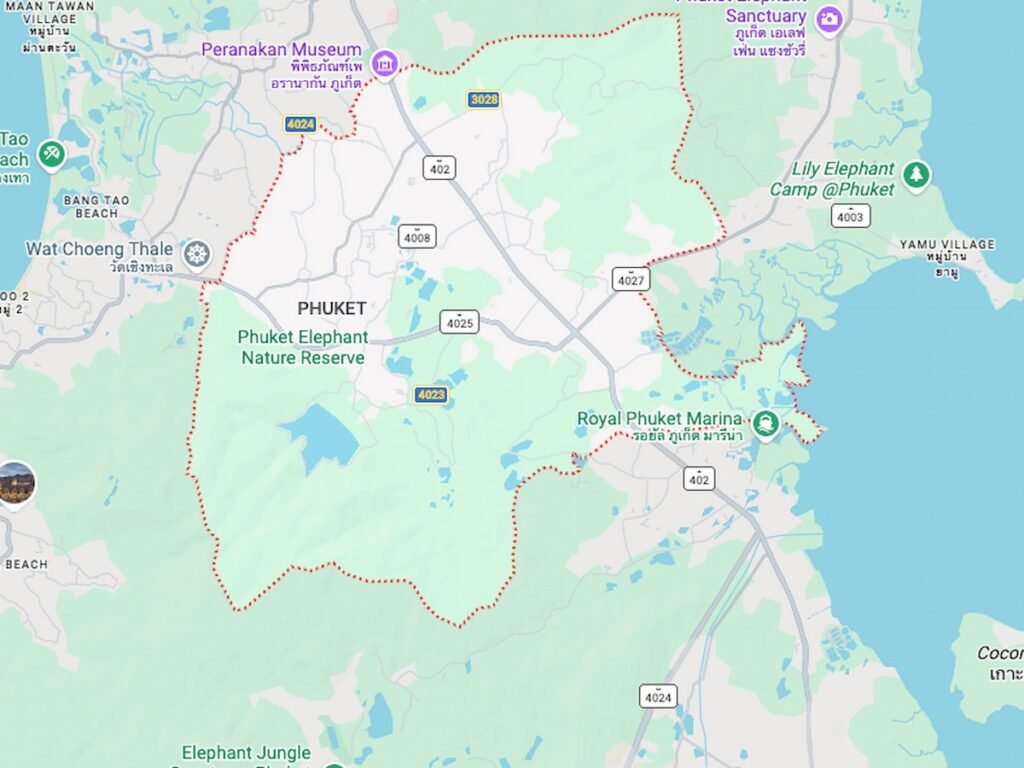
Si Sunthon is the part of Phuket that the rest of the island drives through. It sits in the centre of Thalang District, on and around the Srisoonthorn Road corridor that links Thalang town, the Heroines Monument, and the Cherngtalay and Laguna side of the island. It is not coastal, not dramatically hilly, and not a tourism area. It is a genuine residential and commercial heartland that has grown steadily into one of the more practical places on the island to live and build.
For someone considering building here, whether a private home, a family residence, or a long-term rental, Si Sunthon presents a straightforward proposition with a single honest caveat. It does not carry the coastal setback, mangrove protection, or severe hillside constraints that define the more scenic districts. What it carries instead is the character of a developing road-corridor area, where location relative to the main roads, the pace of surrounding development, and ordinary title and zoning diligence are what actually matter.
This guide is written from an architect’s perspective. It assumes you are at the stage of asking whether Si Sunthon is right for your project, and what a sensible building on land here might look like.
Important update before going further
The headline regulatory change of recent years, the December 2024 relaxation of the 80 to 140 metre elevation rule, is largely irrelevant to most of Si Sunthon, because the area is predominantly low and central rather than elevated hillside. That is itself worth stating plainly: Si Sunthon is one of the few parts of Phuket where the dramatic elevation and coastal rules mostly do not bite.
The points worth knowing for Si Sunthon specifically:
The binding considerations are ordinary residential zoning, the road-corridor planning rules, and standard title diligence, not coastal or severe hillside constraints
The low hills at the district edges still fall under the general slope rules, where a gradient at or above 35 degrees is treated as unbuildable and gentler slopes carry engineering and drainage obligations
The area is actively developing, which means surrounding land use can change around a plot over the life of a project, and that future context matters as much as the plot itself
As everywhere in Thalang, title verification is essential, because a clean-looking inland plot still needs its Chanote and its history confirmed before purchase
The practical consequence is that Si Sunthon is a low-drama area where the value of professional input is less about navigating extreme regulation and more about choosing well within a developing corridor and confirming the ordinary things properly.
The land, what is actually there
Si Sunthon sits inland in central Thalang, organised around the Srisoonthorn Road corridor and the network of lanes running off it. The land is predominantly flat or gently undulating, with low hills only at the district margins. It has no coastline and therefore none of the coastal setback rules, and no significant protected mangrove or wetland system of the kind that constrains the eastern bay areas. The terrain is, by Phuket standards, easy.
This matters for site selection in a different way than in the scenic districts. In Si Sunthon the physical land rarely disqualifies a plot. What varies, and what determines whether a plot is a good one, is its position relative to the main road, its exposure to traffic and noise, the character and pace of development immediately around it, and the ordinary legal status of the title. A flat, buildable plot directly on a busy stretch of Srisoonthorn Road is a very different residential proposition from an equally flat plot on a quiet lane a few hundred metres back, even though the topography is identical.
The area’s defining feature is that it is genuinely developing. New residential projects, commercial premises, and infrastructure continue to appear along and around the corridor. For a buyer this cuts both ways: services and amenities improve over time, but the quiet semi-rural lane a plot sits on today may carry more development and traffic in ten years. A good site assessment in Si Sunthon reads the trajectory of the surrounding area, not just the plot.
Zoning, the road corridor, and title
Phuket construction is governed primarily by the Building Control Act and the Town and City Planning Act, refined by Ministerial Regulations. In Si Sunthon the relevant rules are the ordinary residential and mixed-use zoning categories, the planning rules tied to road access and width, and standard title diligence, rather than the coastal or environmental protections that dominate elsewhere.
The zoning in central Si Sunthon is predominantly residential and mixed-use, which is permissive for the kind of single house, family residence, or small mixed-use building most buyers here are considering. The general inland height position applies rather than the restrictive coastal caps, but the precise permitted height, building area, and use depend on the specific zone colour and the plot’s classification, which must be confirmed for the individual site rather than assumed from the area’s general character.
The road corridor introduces planning considerations that are easy to overlook because they are not scenic. Thai planning rules tie permitted building height and required setback to the width of the access road serving a plot. A plot on a narrow lane can face greater setback requirements and height limits than a plot on a wide road, regardless of the zoning. For a developing corridor area like Si Sunthon, the access road, its width, its legal status, and the right of way to the plot are part of the core feasibility question, not a detail.
The slope rules still apply at the district edges. Where the low hills rise, a gradient at or above 35 degrees is treated as unbuildable, and gentler slopes carry the standard slope-protection, drainage, and engineering obligations. Most of Si Sunthon is flat enough that this does not arise, but a plot taken specifically for a slight elevation or outlook should be slope-checked like any rising land on the island.
Title diligence in Si Sunthon is the ordinary but essential step. The area does not carry the specific protected-land history that makes eastern verdant Phuket especially hazardous, but the universal rule still holds: proceed only on a Chanote, the full freehold title, verified at the Land Office with its history and access rights confirmed by a qualified lawyer. The standard reference points for a Si Sunthon assessment are the Phuket City Land Use Planning Map for the zone classification, the access road status and width, and a clean Land Office title check, verified with the provincial Department of Public Works and Town and Country Planning office and a qualified lawyer before any commitment.
What a good Si Sunthon design responds to
With the land easy and the regulation ordinary, the design drivers in Si Sunthon are the corridor context and the inland climate rather than dramatic site constraints.
The corridor context is the first design response. A plot’s relationship to the main road defines how a good house is arranged on it. Orientation, the placement of private and quiet spaces away from road noise, acoustic detailing toward a busy frontage, and screening or buffer planting between the building and the corridor are the moves that make a Si Sunthon house pleasant to live in. A house that ignores its road relationship in this area is the house that is comfortable on the plan and disappointing in occupation.
The inland climate is the second. Si Sunthon sits away from the coast and does not receive a constant sea breeze, which makes deliberate ventilation design more important rather than less. Cross-ventilation has to be planned into the layout, deep overhangs and shaded openings reduce the cooling load, and high-level openings to exhaust accumulated heat keep the house workable without total reliance on air conditioning. These are the standard tropical disciplines, and on a still inland site they are the difference between low and high running costs over the life of the building.
Drainage is the quieter consideration. Flat inland land can sit and hold water in heavy rain if levels and surface drainage are not designed properly, and the heaviest rain comes late in the year. A flat plot is easy to build on and easy to get wrong on drainage, so finished floor levels and stormwater handling deserve real attention even though the site looks benign in the dry season. Foundation design follows ordinary inland practice, with a plot-specific soil investigation confirming the ground rather than assuming it.
Lifestyle and who Si Sunthon suits
Si Sunthon is not a lifestyle destination and does not try to be. It has a practical local dining and market scene, everyday shops, temples, schools, and the steady infrastructure of a real community, with the larger Cherngtalay and Laguna amenities a short drive away and the airport reasonably close. Its appeal is convenience and normality, not scenery or tourism.
For an architect’s client the choice is about priorities. A coastal or scenic district offers views and tourism potential with the regulatory complexity that comes with them. Si Sunthon offers central location, easy building conditions, steady infrastructure, and value, with the trade that it is ordinary rather than spectacular and is developing rather than settled. The buyers best suited to Si Sunthon are those building a primary residence or a long-term family home who value being central and practical over being scenic, and who understand that the work here is choosing the right plot within a changing corridor rather than conquering a difficult site. It is rarely the right answer for a tourism-yield investment.
A practical sequence for evaluating a Si Sunthon plot
The order of checks in Si Sunthon is less about natural hazards and more about corridor and legal context, but the order still matters.
Start with the title. Confirm a Chanote verified at the Land Office, with the access rights and right of way to the plot confirmed by a qualified lawyer, since access is a real issue on a lane network. Then confirm the zoning classification and the permitted height, area, and use for the specific plot against the current planning map. Then assess the access road, its width and legal status, because it governs setback and height under the planning rules. Then read the surrounding development trajectory honestly, since a quiet lane today may not be quiet in a decade. Only once these are clear should you commission a soil investigation, a drainage assessment, and the beginning of a feasibility brief.
Most reputable architects on the island, including this practice, will conduct a preliminary land viability assessment before any design work begins. In Si Sunthon this is less about whether a plot can physically be built on and more about whether it is the right plot in the right part of a developing corridor, which is a question worth answering before capital is committed rather than after.
Final thoughts
Si Sunthon is the least dramatic area in this series, and that is precisely its strength. There is no coastal setback to navigate, no mangrove protection, and no severe hillside rule on most of its land. What it offers is a central, practical, steadily improving place to build a real home at a sensible cost. The skill here is not in overcoming a hostile site but in choosing well within a changing corridor and getting the ordinary things, title, access, zoning, and drainage, properly right.
For a buyer who wants a calm, central, well-connected home and is realistic about living in a developing rather than a finished area, Si Sunthon is one of the most sensible choices on the island. For a buyer chasing views or tourism yield, it is the wrong place. For the right brief it works quietly and well, which is exactly what it is for.
If you are weighing a plot in Si Sunthon, the most useful first step is a site assessment that addresses title, access, zoning, the development trajectory, and drainage together, not separately. That assessment is offered as the first stage of every project this practice takes on.
Considering land in Si Sunthon, Thalang, Cherngtalay, Pa Khlok, or elsewhere in Phuket? Get in touch for a preliminary land viability assessment. You can also visit our YouTube channel for videos about these areas, and find essential planning advice at www.thetropicalarchitect.com
Note on regulations: zoning, height, setback, slope, and access rules are subject to change and to local enforcement variations, and access road status and title history in particular are areas where verification is essential. Always confirm current rules and the title and access position with the Phuket provincial Department of Public Works and Town and Country Planning office, the Land Office, and a licensed Phuket architect or legal advisor before relying on this guide for any acquisition or build decision.