An architect's guide to land viability, heritage conservation, and what Phuket's historic town asks of a design.
Talad Nuea is one of the two core subdistricts of old Phuket Town, and the single most important thing to understand before building or buying here is that a significant part of it sits inside a formally designated cultural heritage conservation zone. This is not a soft preference or a vague “historic pocket” to be mindful of. The old town conservation area was designated through the Office of Environmental Policy and the National Environment Board, is administered by the municipality and the Old Phuket Foundation, and covers the protected streets, several of which run through or border Talad Nuea, including Krabi Road, Yaowarat Road, Dibuk Road and Ranong Road. Building, extending, altering, or even renovating a facade within that zone is governed by conservation controls, and that fact shapes everything else about building here.
This guide is written from an architect’s perspective. It assumes you are at the stage of asking whether Talad Nuea is right for your project, and what a sound building or renovation here might actually look like. One regulatory point worth noting at the outset: the December 2024 elevation relaxation that matters on hill land elsewhere is largely irrelevant in Talad Nuea, which is predominantly flat town land where the conservation rules, not altitude, are the defining constraint.
The land, what is actually there
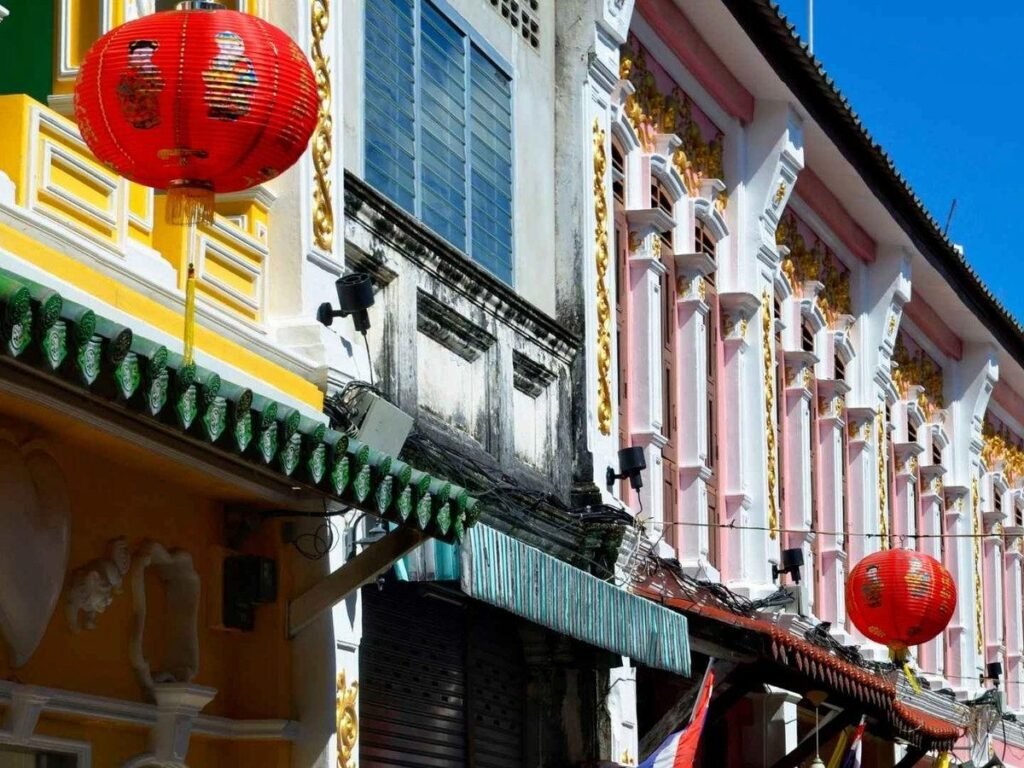
Talad Nuea occupies the northern part of old Phuket Town, predominantly flat urban land of Sino-Portuguese shophouses, heritage mansions, traditional homes, and newer infill, with the ground rising gently to the north and west toward Rang Hill (Khao Rang). The land divides into distinct categories that carry very different rules: land inside the cultural heritage conservation zone, land in the wider town fabric outside the formal zone but still of historic character, the newer residential and mixed areas further out, and the Rang Hill slopes.
This matters for site selection far more than the gentle topography suggests, because in Talad Nuea the category of the land, and specifically whether it falls inside the conservation zone, decides what can be done with it. A heritage shophouse on a protected street is not a plot to be cleared and rebuilt at will; it is a conserved building whose facade, height, roof form, and street character are controlled. A plot just outside the formal zone may still sit in a sensitive historic context where sympathetic design matters in practice. The newer areas behind the old core are ordinary town land. The Rang Hill edge introduces slope. The first question for any Talad Nuea plot is therefore not its size or its price but its precise heritage and zoning status, because that determines what is legally and practically possible before any design begins.
Talad Nuea is a settled, lived-in, multi-generational community rather than a tourist set piece, with active homes and businesses occupying ancestral shophouses. That living-heritage character is part of what makes it valuable and part of what the conservation framework exists to protect.
Zoning, the conservation zone, and title
Phuket construction is governed primarily by the Building Control Act and the Town and City Planning Act, refined by Ministerial Regulations and environmental notifications. In Talad Nuea an additional and decisive layer applies: the cultural heritage conservation framework over the old-town zone, which sits above the ordinary planning rules for any property within it.
Inside the conservation zone, the controls are about preserving the historic streetscape. In practice this governs the building facade and its detailing, the height and roofline so new or altered buildings do not break the historic scale, the treatment of the shopfront and the covered five-foot walkway, materials and colour, and the general requirement that interventions are sympathetic to the Sino-Portuguese character rather than disruptive of it. This is why the area has retained its integrity while remaining a living town, and it is also why a buyer cannot assume that a heritage building can be demolished, heightened, or radically altered. The realistic and rewarding projects inside the zone are careful restorations and conservation-led adaptive reuse, not clean-slate redevelopment. This is precisely the kind of work where an architect who understands both the conservation requirements and the building craft is not optional but essential, and where proceeding without that expertise risks both refusal and the destruction of the value that made the building worth buying.
Outside the formal zone but within the wider historic town, the ordinary residential and mixed-use zoning applies, with the general inland height position, the precise permitted height, area, and use depending on the specific zone, and the access road width and status governing setback and height on the narrow old-town lanes. On the Rang Hill edge, the slope rules apply, with a gradient at or above 35 degrees treated as unbuildable and gentler slopes carrying slope-protection, drainage, and engineering obligations.
Title diligence follows the universal rule, with a heritage dimension in the old core. Proceed only on a Chanote, the full freehold title, verified at the Land Office with history, boundary, and access confirmed by a qualified lawyer, and the foreign-quota position verified where the route is condominium freehold. For any property in or near the conservation zone, the diligence must also establish the building’s heritage status and exactly what conservation controls apply, because that defines the project before the design does. The standard reference points for a Talad Nuea assessment are the Phuket City Land Use Planning Map for zoning, the cultural heritage conservation zone boundary and the specific controls on the property, the slope position on any Rang Hill plot, the access road status, and a clean Land Office title check, all verified with the provincial Department of Public Works and Town and Country Planning office, the municipality, and a qualified lawyer before any commitment.
What a good Talad Nuea design responds to
The design drivers in Talad Nuea are the heritage fabric, the dense urban grain, the tropical climate within a constrained envelope, and the living-community context.
The heritage fabric is the first and defining response. For a conservation-zone building, good design is restoration and sympathetic adaptive reuse: retaining and repairing the original facade, structure, roof tiles, and detailing; respecting the historic height and the rhythm of the street; keeping the covered walkway; and inserting modern function (comfort, services, contemporary interiors) behind a preserved exterior rather than through it. The best old-town projects are invisible from the street and transformed within, and achieving that is a specialist architectural discipline rather than a generic build.
The dense urban grain is the second. Shophouse plots are typically narrow and deep with shared party walls, limited frontage, and little or no setback, so the design problems are light, ventilation, and privacy within a tight envelope. The traditional Sino-Portuguese solution, the internal air well or courtyard that brings light and ventilation into a deep narrow plan, is also the correct contemporary solution, and a good design works with that logic rather than against it.
The tropical climate within that constrained envelope is the third. The traditional building handled heat and monsoon through the air well, high ceilings, the shaded covered walkway, and cross-ventilation, and a sensitive modern intervention reinforces these rather than sealing the building and relying entirely on air conditioning, which both raises running costs and damages the historic fabric through trapped moisture. The living-community context is the fourth driver: a project here sits among occupied family shophouses and active businesses, so construction logistics, party-wall responsibilities, and respect for neighbours are real design and process considerations, not afterthoughts. On the Rang Hill edge, ordinary hillside discipline and a plot-specific soil and drainage investigation apply.
Lifestyle and who Talad Nuea suits
Talad Nuea offers a distinctive urban-heritage lifestyle: a walkable historic town of shophouses, cafes, museums, shrines, and markets, genuine local and Baba Peranakan culture, the Rang Hill viewpoints and green space nearby, central access to Phuket Town’s administrative offices, hospitals and schools, and the west-coast beaches a reasonable drive away. It is lived-in, cultural, and characterful rather than coastal or resort-like. Its appeal is heritage, walkability, authenticity, and steady rather than speculative value, and its central consideration is the conservation framework that both constrains and protects it.
For an architect’s client the choice is about priorities and project type. Talad Nuea suits a buyer who wants a heritage restoration or a conservation-led adaptive reuse, a boutique guesthouse, gallery, residence or small business in a genuine historic town, and who values character and culture over coastline and who understands that the building is conserved rather than a free canvas. It also suits buyers of ordinary homes in the newer fabric just outside the core. It is rarely the right area for a buyer wanting a blank-slate modern villa or beachfront lifestyle, and never a place to buy a heritage building intending to demolish or radically alter it. For the right brief, a well-handled old-town restoration is among the most rewarding and enduring projects on the island.
A practical sequence for evaluating a Talad Nuea plot
In Talad Nuea the order of checks is led by the heritage-status question, because that defines what the project can be.
Start, before any commitment, by establishing whether the property sits inside the cultural heritage conservation zone and exactly what conservation controls apply to it, alongside the title, a Chanote verified at the Land Office with boundary and access confirmed by a qualified lawyer, or the foreign-quota position if the route is condominium freehold. Treat the heritage-status finding as the stage that defines the brief. Then confirm the ordinary zoning classification and the permitted height, area, and use for any non-conservation plot, the access road status on the narrow lanes, and the slope position on any Rang Hill plot. Only once these are clear should you commission a building condition survey for any heritage structure, a soil and drainage investigation where relevant, and a feasibility brief shaped by the conservation requirements.
Most reputable architects on the island, including this practice, will conduct a preliminary land viability assessment before any design work begins. In Talad Nuea this is not a formality. A heritage building bought without understanding its conservation controls can be both unalterable in the ways the buyer assumed and damaged in value by inappropriate work, and that has to be understood before capital is committed rather than after.
Final thoughts
Talad Nuea is one of the most characterful and culturally rich places to own property on Phuket, and its value is inseparable from the conservation framework that has preserved it. The heritage zone is not an obstacle to be worked around; it is the reason the area is worth being in, and a building or restoration here succeeds by being designed with the conservation rules and the historic fabric rather than against them.
For a buyer who wants a genuine heritage restoration or a sensitive adaptive reuse in a living historic town, who values culture and authenticity, and who treats the heritage-status and conservation-control verification as the decisive first step, Talad Nuea is among the most rewarding and enduring places to build on the island. For a buyer who assumes a heritage building can be cleared or radically altered, it is a place where that assumption fails both legally and in value. For the right brief, handled with the specialist care the conservation context demands, it is exceptional.
If you are weighing a property in Talad Nuea, the most useful and most necessary first step is a site assessment that establishes the heritage and conservation status first, then title, zoning, and access together, not separately. That assessment is offered as the first stage of every project this practice takes on.
Considering property in Talad Nuea, Talad Yai, Phuket Town, or elsewhere in Phuket? Get in touch for a preliminary land viability assessment. You can also visit our YouTube channel for videos about these areas, and find essential planning advice at www.thetropicalarchitect.com
Note on regulations: zoning, height, conservation-zone, slope, and title rules are subject to change and to local enforcement variations, and in Talad Nuea the cultural heritage conservation controls and the precise heritage status of any property in or near the old-town zone are matters to verify with particular care for any specific building or plot. Always confirm current rules and the title, heritage status, and conservation requirements with the Phuket provincial Department of Public Works and Town and Country Planning office, the municipality, the Land Office, and a licensed Phuket architect or legal advisor before relying on this guide for any acquisition or build decision.
Reading this alongside the rest of Phuket
If Talad Nuea is on your shortlist, the neighbouring areas are worth reading alongside it, because the land rules and the character of a place change quickly across a few kilometres in Phuket. See the guides to Talad Yai, Kathu and Rassada.
Before any specific plot, the four briefings that apply island-wide are the Phuket property overview, what a villa really costs to build, the ownership routes that work for foreigners and the process of buying land. When you are ready to talk about a particular piece of land, this is how the work with Nay runs.